

DTF Course - Certification
Course
- source_url: https://ambitious.academy/course/dtf-course-certification
- dump Date: 2026-08-21 (academy.jsonl Last-Modified Fri, 21 Aug 2026 09:25:14 GMT; fetched_at_utc 2026-08-21T10:42:48Z = 12:42 SAST)
- export post_date: 2026-05-08 09:10:10
- post_author: 28
- post_status: publish
- post_excerpt: (empty)
- post_parent: 0
- comment_status: closed
- comment_count: 0
- course_expire_enrollment: 0
- course_type: paid
- course_product_id: 5860
- course_download_id: 0
- course_max_students: 0
- course_language: (empty)
- course_difficulty_level: all_levels
- course_benefits: (empty)
- course_requirements: (empty)
- course_audience: (empty)
- course_materials: (empty)
- is_enabled_course_qa: 1
- is_enabled_course_announcements: 1
- course_certificate_id: 2471
- is_disabled_course_review: (empty)
- rcp_membership_levels: []
- course_enable_certificate: 1
- edd_price: (empty)
- regular_price: 40
- sale_price: (empty)
- course_duration: 0 hours, 0 minutes, 0 seconds (raw [0,0,0])
- course_intro_video kind: none
- course_intro_video raw: []
- catalog Title: DTF Course - Certification
- catalog url: https://ambitious.academy/course/dtf-course-certification
- content merge: export HTML and jsonl catalog text differ — academy.jsonl dump (2026-08-21) is newer than export post_date; both kept in full. Older export kept as history below; catalog kept as dump text.
Curriculum
Curriculum sections (from course_curriculum):
- section: Information
- section: Examinations
Curriculum topics (id / name / type) in export order:
- id 442 · lesson · About DTFC
- id 43 · lesson · How To Follow Along
- id 5755 · quiz · Exam - DTFC
- id 443 · lesson · Practical - DTFC
- id 167 · lesson · Exam Assessment & Results
Raw course_curriculum (export, kept in full):
[{"title":"Information","content":"","topics":[{"id":442,"name":"About DTFC","type":"lesson"},{"id":43,"name":"How To Follow Along","type":"lesson"}]},{"title":"Examinations","content":"","topics":[{"id":5755,"name":"Exam - DTFC","type":"quiz"},{"id":443,"name":"Practical - DTFC","type":"lesson"},{"id":167,"name":"Exam Assessment & Results","type":"lesson"}]}]
Course content (academy.jsonl catalog)
dump Date 2026-08-21 (academy.jsonl Last-Modified Fri, 21 Aug 2026 09:25:14 GMT; fetched_at_utc 2026-08-21T10:42:48Z = 12:42 SAST). Public visit link is source_url (paywall).
-
The culminating step of this course is a Professional Competency Assessment designed to verify your mastery of the DTF production workflow, from digital file preparation in InkRIP to machine calibration and final heat-press application.
-
Part 1: DTF Theory Assessment -
-
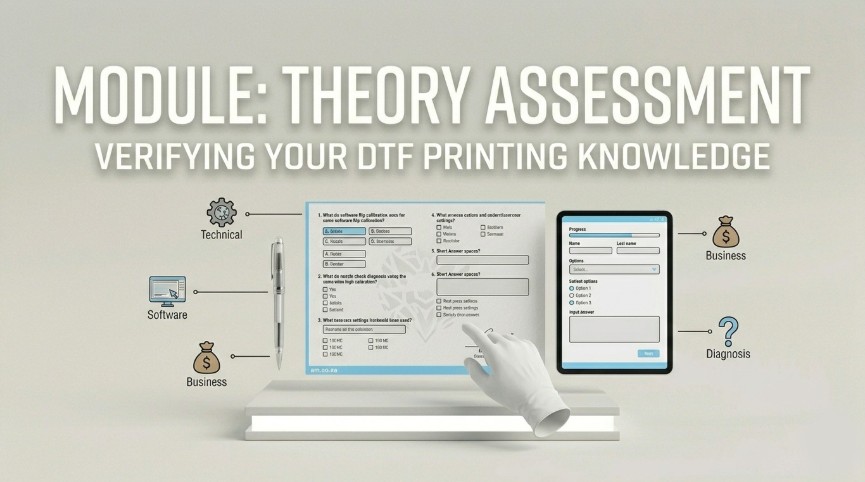
This multiple-choice section tests your foundational knowledge of DTF-specific technical standards:
-
Workflow Software: You must master the sequence of actions from RIP to Control . This includes understanding the role of Nesting to reduce material waste and Tiling for oversized designs. Color Pre-Press: Proficiency in file preparation, including maintaining a minimum of 300 DPI for quality and setting the crucial white ink choke to prevent color bleed. Maintenance Calibration: Knowledge of the purpose and execution of the Nozzle Check , head alignment, and the maintenance of components like the Capping Station and Encoder Strip . Materials Safety: Understanding the properties of DTF Inks (White/CMYK) , adhesive powders, and the importance of fume extraction/safety during the curing process. -
Part 2: DTF Practical Assessment -
-
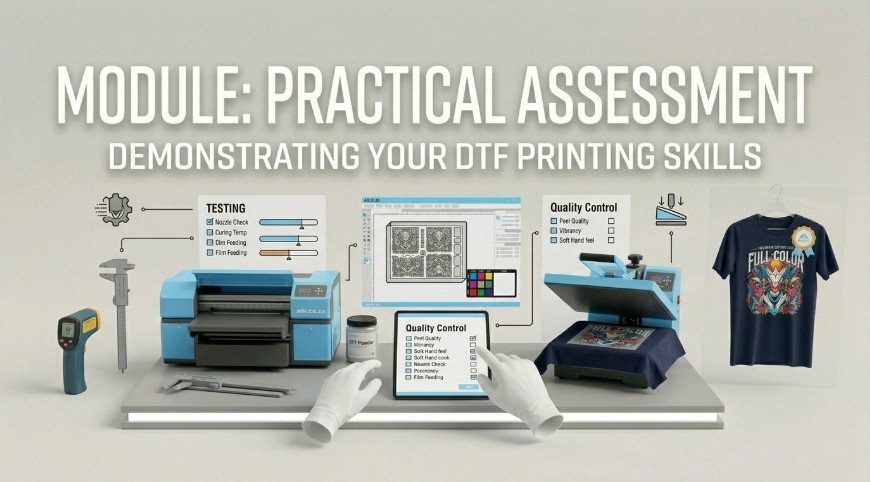
This simulation requires you to execute and document a full production cycle, focusing on efficiency and technical accuracy:
-
Simulated Pre-Press: Demonstrate importing a high-resolution PNG or TIFF, checking resolution, and selecting the correct ICC Profile for the specific DTF film and ink combination. Efficiency Demonstration: You must submit documentation (screenshots) showing the most material-efficient nesting of multiple jobs (such as the "Elite Sport Barista" gym brief) on your specified roll width. Execution Validation: Detail the correct sequence for sending the "Ripped" file to Control , setting the origin, and executing the print. Application Quality Control: Document the final steps of the workflow, including correct powder application, curing to an "orange peel" texture , and the final heat-press application (Pre-press, Primary Press, Cold Peel, and Finishing Press). -
Certification Recommendation -
Before attempting the official exam, students are recommended to complete all seven modules of the online DTF Printing course , including all knowledge checks and the final Capstone Project .
Course content (export post_content)
History from export post_date 2026-05-08 09:10:10. Full HTML converted; nothing summarized.

-
The culminating step of this course is a Professional Competency Assessment designed to verify your mastery of the DTF production workflow, from digital file preparation in InkRIP to machine calibration and final heat-press application.
-
Part 1: DTF Theory Assessment
-
-
This multiple-choice section tests your foundational knowledge of DTF-specific technical standards:
-
- Workflow & Software: You must master the sequence of actions from RIP to Control. This includes understanding the role of Nesting to reduce material waste and Tiling for oversized designs.
- Color & Pre-Press: Proficiency in file preparation, including maintaining a minimum of 300 DPI for quality and setting the crucial white ink choke to prevent color bleed.
- Maintenance & Calibration: Knowledge of the purpose and execution of the Nozzle Check, head alignment, and the maintenance of components like the Capping Station and Encoder Strip.
- Materials & Safety: Understanding the properties of DTF Inks (White/CMYK), adhesive powders, and the importance of fume extraction/safety during the curing process.
-
Part 2: DTF Practical Assessment
-
-
This simulation requires you to execute and document a full production cycle, focusing on efficiency and technical accuracy:
-
- Simulated Pre-Press: Demonstrate importing a high-resolution PNG or TIFF, checking resolution, and selecting the correct ICC Profile for the specific DTF film and ink combination.
- Efficiency Demonstration: You must submit documentation (screenshots) showing the most material-efficient nesting of multiple jobs (such as the "Elite Sport & Barista" gym brief) on your specified roll width.
- Execution Validation: Detail the correct sequence for sending the "Ripped" file to Control, setting the origin, and executing the print.
- Application & Quality Control: Document the final steps of the workflow, including correct powder application, curing to an "orange peel" texture, and the final heat-press application (Pre-press, Primary Press, Cold Peel, and Finishing Press).
-
Certification Recommendation
-
Before attempting the official exam, students are recommended to complete all seven modules of the onlineDTF Printingcourse, including all knowledge checks and the final Capstone Project.
Lessons
Nest order. 4 lessons. Overlapping titles kept as separate lessons. HTML converted in full, not summarized.
1. About DTFC
- title: About DTFC
- status: publish
- author: 0
- is_previewable: (empty)
- video_duration: 0h 0m 0s (raw {"hours":0,"minutes":0,"seconds":0})
- video_source_type: (empty)
DTF Certification Overview
The culminating step of this course is a Professional Competency Assessment designed to verify your mastery of the DTF production workflow, from digital file preparation in InkRIP to machine calibration and final heat-press application.
Part 1: DTF Theory Assessment
This multiple-choice section tests your foundational knowledge of DTF-specific technical standards:
- Workflow & Software: You must master the sequence of actions from RIP to Control. This includes understanding the role of Nesting to reduce material waste and Tiling for oversized designs.
- Color & Pre-Press: Proficiency in file preparation, including maintaining a minimum of 300 DPI for quality and setting the crucial white ink choke to prevent color bleed.
- Maintenance & Calibration: Knowledge of the purpose and execution of the Nozzle Check, head alignment, and the maintenance of components like the Capping Station and Encoder Strip.
- Materials & Safety: Understanding the properties of DTF Inks (White/CMYK), adhesive powders, and the importance of fume extraction/safety during the curing process.
Part 2: DTF Practical Assessment
This simulation requires you to execute and document a full production cycle, focusing on efficiency and technical accuracy:
- Simulated Pre-Press: Demonstrate importing a high-resolution PNG or TIFF, checking resolution, and selecting the correct ICC Profile for the specific DTF film and ink combination.
- Efficiency Demonstration: You must submit documentation (screenshots) showing the most material-efficient nesting of multiple jobs (such as the "Elite Sport & Barista" gym brief) on your specified roll width.
- Execution Validation: Detail the correct sequence for sending the "Ripped" file to Control, setting the origin, and executing the print.
- Application & Quality Control: Document the final steps of the workflow, including correct powder application, curing to an "orange peel" texture, and the final heat-press application (Pre-press, Primary Press, Cold Peel, and Finishing Press).
Certification Recommendation
Before attempting the official exam, students are recommended to complete all seven modules of the onlineDTF Printingcourse, including all knowledge checks and the final Capstone Project.
2. How To Follow Along
- title: How To Follow Along
- status: publish
- author: 0
- is_previewable: 1
- video_duration: 0h 0m 0s (raw {"hours":0,"minutes":0,"seconds":0})
- video_source_type: (empty)
In this section we will be looking at some important things for a student to bear in mind throughout the course.
Progression
- If it is your first time doing the course, we would recommend that you follow along from start to finish without skipping content.
- If you have completed a lesson and it was not automatically marked as complete, you will have to mark it manually as completed.

Quizzes
- After important lessons we have added quizzes, these will help you better retain the lessons learned within that topic.
- The quizzes have no limit in regard to the number of attempts.
Q&A
- If you have any questions that need answers, please leave them below each lesson in the Q&A section.

- Keep questions relevant to the lesson at hand.
- Before leaving a question, ensure that a similar question has not been asked and answered already.
Practise
- Theory without practice is not as effective as practising what you've learned.
- The more you practise what has been shown in these lessons, the more value this course will have for you.
Bonus Things
- At the end of the course we have a section called Bonus Things; this section will be used to add any content and lessons that we did not cover throughout the course.

- This section will also grow overtime, so make sure to come and look for updates from time to time.
-
If you have any suggestions for content to cover on Vinyl Cutting, feel free to leave your suggestions within the Q&A section for the Bonus Things.
-
quizzes_following_this_lesson: 1 (full text in Quizzes)
- Exam - DTFC (18 questions)
3. Practical - DTFC
- title: Practical - DTFC
- status: publish
- author: 0
- is_previewable: (empty)
- video_duration: 0h 0m 0s (raw {"hours":0,"minutes":0,"seconds":0})
- video_source_type: (empty)
- drive_file_id:
19BJQeF1B7HISk6uUlcfnfAJ0Z8aruNFW(source_ref; not a public link) - transcript pending / keyframes pending / presentation extract pending
New Practical Brief: "Elite Sport & Barista" Kit

The Scenario: A high-end gym and coffee bar, "Volt & Velocity," needs a branding kit for a promotional event. Because this is a professional competency assessment, you must verify your mastery of the entire production workflow.
Optional: Use your own band design for the practical
1. The Order Specifications
- Item 1: 2x Performance Polyester Tees (White)
- Design: Large Chest Logo (220mm wide).
- Challenge: Must be pressed at a lower temperature to avoid "heat press marks" on polyester.
- Item 2: 2x Heavy Canvas Tote Bags (White)
- Design: Double-sided branding (150mm wide).
- Challenge: Requires high pressure and longer dwell time for the coarse texture.
- Item 3: 2x "Member" Baseball Caps (White)
- Design: Small front-center logo (60mm wide).
- Challenge: Efficient nesting of 10 identical small units, but only press on 2.
2. Practical Submission Requirements (The Digital Portfolio)
As this is an online assessment, you must submit documented proof (screenshots and write-ups) of your setup.
Task A: Advanced Nesting & Efficiency
- Requirement 1: Submit a screenshot showing the Nesting of all three jobs (Tees, Totes, and Caps) on a single 60cm wide roll.
- Requirement 2: Demonstrate efficiency by detailing the total film used and how you arranged the small cap logos to fill the gaps between the large tee designs.
Task B: Material-Specific Execution Logic
- Requirement 3: Submit a Pressure and Temperature Table for this order. You must detail why the settings for the Polyester Tee differ from the Canvas Tote.
- Requirement 4: Detail the correct three-step sequence for printing this complex job using PrintEXP.
Task C: Quality Validation (Photo Proofs)
- Requirement 5: Submit a macro photo of the cured white ink underbase, showing a 3-pixel Choke to ensure no white edges are visible on the neon polyester.
- Requirement 6: Submit a photo of the final applied "Stretch Test" on the polyester garment to prove the bond is flexible and durable.
Submission Instructions:
Complete any write-ups, screenshots, photos or videos then submit via email to the instructor at info@ambitious.co.za.
4. Exam Assessment & Results
- title: Exam Assessment & Results
- status: publish
- author: 0
- is_previewable: (empty)
- video_duration: 0h 0m 0s (raw {"hours":0,"minutes":0,"seconds":0})
- video_source_type: (empty)
**

**
Exam Assessment and Results
Thank you for completing the Exam!
Please be aware that your exam submission-particularly the Practical Assessment-requires manual review by a certified instructor.
What Happens Next:
- Instructor Review: An instructor will thoroughly evaluate your theoretical answers and your submitted documentation, images and videos for the practical component to ensure all specifications were met.
- Assessment Timeframe: Review and grading typically take 5-10 business days from the time of submission.
- Notification: Once the assessment is complete, you will be notified with your final score and, upon passing, your official certification credentials.
We appreciate your patience during this review process. Congratulations on taking this final step!
Quizzes
1 quizzes in nest order, each under the lesson it followed. Every question and every answer is kept, including answer_is_correct.
After lesson: How To Follow Along
Quiz: Exam - DTFC
- follows_lesson: How To Follow Along
- quiz_content: (empty)
- quiz_time: 0
- quiz_time_unit: minutes
- quiz_hide_time: (empty)
- quiz_feedback_mode: retry
- quiz_passing_grade: 80
- quiz_max_attempts_allowed: 0
- quiz_questions_order: rand
- quiz_hide_question_number: (empty)
- quiz_questions_layout: single
- quiz_explanation_enabled: (empty)
- quiz_skip_question_showing: (empty)
- question_count: 18
Question 1: Minimize Waste
- question_type: singleChoice
- question_points: 1.00
- question_status: publish
- question_display_points: 1
- question_answer_required: 1
- question_randomize: (empty)
- question_order: 0
- question_negative_score: 0.00
- question_content: Which software technique allows a Production Manager to fit multiple different jobs onto one width of film to minimize waste?
- question_explanation: (empty)
Answers (4):
-
- [incorrect] answer_is_correct=0 · view_format=text · Tiling
-
- [CORRECT] answer_is_correct=1 · view_format=text · Nesting (Gang Sheets)
-
- [incorrect] answer_is_correct=0 · view_format=text · Vectorizing
-
- [incorrect] answer_is_correct=0 · view_format=text · Rasterizing
Question 2: Finishing Press
- question_type: singleChoice
- question_points: 1.00
- question_status: publish
- question_display_points: 1
- question_answer_required: 1
- question_randomize: (empty)
- question_order: 0
- question_negative_score: 0.00
- question_content: What is the purpose of the "Finishing Press" (Second Press) after the film has been removed?
- question_explanation: (empty)
Answers (4):
-
- [incorrect] answer_is_correct=0 · view_format=text · To clean any remaining powder off the shirt.
-
- [incorrect] answer_is_correct=0 · view_format=text · To dry the ink further.
-
- [incorrect] answer_is_correct=0 · view_format=text · To make the print feel thicker and more like a sticker.
-
- [CORRECT] answer_is_correct=1 · view_format=text · To drive the ink deeper into the fabric fibers for better washability.
Question 3: Control Software Format
- question_type: singleChoice
- question_points: 1.00
- question_status: publish
- question_display_points: 1
- question_answer_required: 1
- question_randomize: (empty)
- question_order: 0
- question_negative_score: 0.00
- question_content: Which file format is generated by the RIP software to be "executed" by the printer control software (PrintEXP)?
- question_explanation: (empty)
Answers (4):
-
- [incorrect] answer_is_correct=0 · view_format=text · .JPG or .PNG
-
- [incorrect] answer_is_correct=0 · view_format=text · .PDF or .SVG
-
- [CORRECT] answer_is_correct=1 · view_format=text · .PRN or .RTL
-
- [incorrect] answer_is_correct=0 · view_format=text · .AI or .EPS
Question 4: Horizontal Banding
- question_type: singleChoice
- question_points: 1.00
- question_status: publish
- question_display_points: 1
- question_answer_required: 1
- question_randomize: (empty)
- question_order: 0
- question_negative_score: 0.00
- question_content: If your print shows consistent horizontal "banding" (white lines through the image), which calibration should be performed first?
- question_explanation: (empty)
Answers (4):
-
- [incorrect] answer_is_correct=0 · view_format=text · Horizontal Mirroring
-
- [incorrect] answer_is_correct=0 · view_format=text · Voltage Calibration
-
- [incorrect] answer_is_correct=0 · view_format=text · Temperature Calibration
-
- [CORRECT] answer_is_correct=1 · view_format=text · Feed Calibration / Step Calibration
Question 5: Perfect Cure
- question_type: singleChoice
- question_points: 1.00
- question_status: publish
- question_display_points: 1
- question_answer_required: 1
- question_randomize: (empty)
- question_order: 0
- question_negative_score: 0.00
- question_content: What is the visual indicator of a "Perfect Cure" for DTF adhesive powder?
- question_explanation: (empty)
Answers (4):
-
- [incorrect] answer_is_correct=0 · view_format=text · A smooth, flat, paper-like finish.
-
- [CORRECT] answer_is_correct=1 · view_format=text · A shiny, transparent "orange peel" texture.
-
- [incorrect] answer_is_correct=0 · view_format=text · A bubbly, smoking surface.
-
- [incorrect] answer_is_correct=0 · view_format=text · A brittle, yellowed appearance.
Question 6: Sugary Matte Look.
- question_type: singleChoice
- question_points: 1.00
- question_status: publish
- question_display_points: 1
- question_answer_required: 1
- question_randomize: (empty)
- question_order: 0
- question_negative_score: 0.00
- question_content: During the curing process, you observe the powder has a white, "sugary" matte look. What does this indicate?
- question_explanation: (empty)
Answers (4):
-
- [incorrect] answer_is_correct=0 · view_format=text · The film is perfectly cured.
-
- [incorrect] answer_is_correct=0 · view_format=text · The film is over-cured and burnt.
-
- [CORRECT] answer_is_correct=1 · view_format=text · The film is under-cured and requires more time/heat.
-
- [incorrect] answer_is_correct=0 · view_format=text · The wrong type of ink was used.
Question 7: Paper Test
- question_type: singleChoice
- question_points: 1.00
- question_status: publish
- question_display_points: 1
- question_answer_required: 1
- question_randomize: (empty)
- question_order: 0
- question_negative_score: 0.00
- question_content: The "Paper Test" is used during the calibration of a heat press to verify which setting?
- question_explanation: (empty)
Answers (4):
-
- [incorrect] answer_is_correct=0 · view_format=text · Temperature accuracy
-
- [CORRECT] answer_is_correct=1 · view_format=text · Firm and even Pressure
-
- [incorrect] answer_is_correct=0 · view_format=text · Alignment accuracy
-
- [incorrect] answer_is_correct=0 · view_format=text · Timer countdown speed
Question 8: Golden Rule
- question_type: singleChoice
- question_points: 1.00
- question_status: publish
- question_display_points: 1
- question_answer_required: 1
- question_randomize: (empty)
- question_order: 0
- question_negative_score: 0.00
- question_content: What is the "Golden Rule" of DTF orientation before clicking the "RIP" button?
- question_explanation: (empty)
Answers (4):
-
- [incorrect] answer_is_correct=0 · view_format=text · Rotate the image 90 degrees clockwise.
-
- [incorrect] answer_is_correct=0 · view_format=text · Upscale the image by 200%.
-
- [CORRECT] answer_is_correct=1 · view_format=text · Mirror the image horizontally.
-
- [incorrect] answer_is_correct=0 · view_format=text · Convert all text to outlines in the RIP.
Question 9: 100% Polyester
- question_type: singleChoice
- question_points: 1.00
- question_status: publish
- question_display_points: 1
- question_answer_required: 1
- question_randomize: (empty)
- question_order: 0
- question_negative_score: 0.00
- question_content: You are printing on 100% Polyester. To avoid "dye migration" or scorching the fabric, what adjustment is usually made?
- question_explanation: (empty)
Answers (4):
-
- [incorrect] answer_is_correct=0 · view_format=text · Increase pressure and increase heat.
-
- [CORRECT] answer_is_correct=1 · view_format=text · Decrease heat and increase dwell time.
-
- [incorrect] answer_is_correct=0 · view_format=text · Peel the film while it is steaming hot.
-
- [incorrect] answer_is_correct=0 · view_format=text · Remove the White Ink layer entirely.
Question 10: White Ink Agitation
- question_type: singleChoice
- question_points: 1.00
- question_status: publish
- question_display_points: 1
- question_answer_required: 1
- question_randomize: (empty)
- question_order: 0
- question_negative_score: 0.00
- question_content: What is the primary reason white ink requires more agitation than CMYK inks?
- question_explanation: (empty)
Answers (4):
-
- [CORRECT] answer_is_correct=1 · view_format=text · It contains Titanium Dioxide, which is heavy and settles at the bottom of the tank.
-
- [incorrect] answer_is_correct=0 · view_format=text · It reacts faster to sunlight.
-
- [incorrect] answer_is_correct=0 · view_format=text · It is more expensive.
-
- [incorrect] answer_is_correct=0 · view_format=text · It is water-based while CMYK is oil-based.
Question 11: Horizontal Position
- question_type: singleChoice
- question_points: 1.00
- question_status: publish
- question_display_points: 1
- question_answer_required: 1
- question_randomize: (empty)
- question_order: 0
- question_negative_score: 0.00
- question_content: Which component is responsible for helping the printer "track" the exact horizontal position of the carriage?
- question_explanation: (empty)
Answers (4):
-
- [incorrect] answer_is_correct=0 · view_format=text · The Capping Station
-
- [incorrect] answer_is_correct=0 · view_format=text · The Dampers
-
- [incorrect] answer_is_correct=0 · view_format=text · The Wiper Blade
-
- [CORRECT] answer_is_correct=1 · view_format=text · The Encoder Strip
Question 12: Color Space
- question_type: singleChoice
- question_points: 1.00
- question_status: publish
- question_display_points: 1
- question_answer_required: 1
- question_randomize: (empty)
- question_order: 0
- question_negative_score: 0.00
- question_content: When preparing files for a DTF printer, which color space should your design ideally be exported in to match the printer's ink system?
- question_explanation: (empty)
Answers (4):
-
- [CORRECT] answer_is_correct=1 · view_format=text · CMYK
-
- [incorrect] answer_is_correct=0 · view_format=text · RGB
-
- [incorrect] answer_is_correct=0 · view_format=text · Grayscale
-
- [incorrect] answer_is_correct=0 · view_format=text · Pantone Spot Colors
Question 13: White Line Peeking
- question_type: singleChoice
- question_points: 1.00
- question_status: publish
- question_display_points: 1
- question_answer_required: 1
- question_randomize: (empty)
- question_order: 0
- question_negative_score: 0.00
- question_content: You notice a thin white line peeking out from the edges of your colored design on a black shirt. Which setting must be adjusted in the RIP software?
- question_explanation: (empty)
Answers (4):
-
- [incorrect] answer_is_correct=0 · view_format=text · ICC Profile (change to Matte)
-
- [incorrect] answer_is_correct=0 · view_format=text · Resolution (increase DPI)
-
- [incorrect] answer_is_correct=0 · view_format=text · Ink Density (set to 100%)
-
- [CORRECT] answer_is_correct=1 · view_format=text · White Ink Choke (increase pixels)
Question 14: Capping Station Health
- question_type: singleChoice
- question_points: 1.00
- question_status: publish
- question_display_points: 1
- question_answer_required: 1
- question_randomize: (empty)
- question_order: 0
- question_negative_score: 0.00
- question_content: Why is the "Capping Station" considered the most critical part for printhead health during idle time?
- question_explanation: (empty)
Answers (4):
-
- [incorrect] answer_is_correct=0 · view_format=text · It cleans the dust off the film.
-
- [CORRECT] answer_is_correct=1 · view_format=text · It creates an airtight seal to prevent the ink in the nozzles from drying out.
-
- [incorrect] answer_is_correct=0 · view_format=text · It calculates the amount of waste ink generated.
-
- [incorrect] answer_is_correct=0 · view_format=text · It pre-heats the ink before printing.
Question 15: Minimum Resolution
- question_type: singleChoice
- question_points: 1.00
- question_status: publish
- question_display_points: 1
- question_answer_required: 1
- question_randomize: (empty)
- question_order: 0
- question_negative_score: 0.00
- question_content: What is the industry-standard minimum resolution (DPI) required for a DTF transfer to maintain professional sharpness at a standard viewing distance?
- question_explanation: (empty)
Answers (4):
-
- [incorrect] answer_is_correct=0 · view_format=text · 72 DPI
-
- [incorrect] answer_is_correct=0 · view_format=text · 150 DPI
-
- [incorrect] answer_is_correct=0 · view_format=text · 1200 DPI
-
- [CORRECT] answer_is_correct=1 · view_format=text · 300 DPI
Question 16: RIP software
- question_type: singleChoice
- question_points: 1.00
- question_status: publish
- question_display_points: 1
- question_answer_required: 1
- question_randomize: (empty)
- question_order: 0
- question_negative_score: 0.00
- question_content: In a professional DTF environment, what is the primary role of the RIP software (e.g., InkRIP)?
- question_explanation: (empty)
Answers (4):
-
- [CORRECT] answer_is_correct=1 · view_format=text · To translate raster/vector data into printer-ready language and manage color layers.
-
- [incorrect] answer_is_correct=0 · view_format=text · To design the artwork from scratch using vector tools.
-
- [incorrect] answer_is_correct=0 · view_format=text · To monitor the temperature of the heat press.
-
- [incorrect] answer_is_correct=0 · view_format=text · To drive the mechanical movements of the printhead.
Question 17: Safety Concern
- question_type: singleChoice
- question_points: 1.00
- question_status: publish
- question_display_points: 1
- question_answer_required: 1
- question_randomize: (empty)
- question_order: 0
- question_negative_score: 0.00
- question_content: What is the specific safety concern regarding the "baking" or curing of DTF powder and ink?
- question_explanation: (empty)
Answers (4):
-
- [incorrect] answer_is_correct=0 · view_format=text · High-frequency noise.
-
- [incorrect] answer_is_correct=0 · view_format=text · Risk of static electricity shock.
-
- [incorrect] answer_is_correct=0 · view_format=text · UV light exposure.
-
- [CORRECT] answer_is_correct=1 · view_format=text · Release of VOCs (Volatile Organic Compounds) requiring ventilation.
Question 18: Hot Peeling Risk
- question_type: singleChoice
- question_points: 1.00
- question_status: publish
- question_display_points: 1
- question_answer_required: 1
- question_randomize: (empty)
- question_order: 0
- question_negative_score: 0.00
- question_content: What is the risk of "Hot Peeling" a film that is specifically rated as a "Cold Peel" product?
- question_explanation: (empty)
Answers (4):
-
- [incorrect] answer_is_correct=0 · view_format=text · The ink will turn a different color.
-
- [incorrect] answer_is_correct=0 · view_format=text · The garment will shrink.
-
- [incorrect] answer_is_correct=0 · view_format=text · The heat press will lose its calibration.
-
- [CORRECT] answer_is_correct=1 · view_format=text · The design may lift off the garment or have "ragged" edges.
Sources
- source_url: https://ambitious.academy/course/dtf-course-certification
- source_ref: academy.jsonl (dumps-check; public catalog dump)
- source_ref: nested Course export b72d7de272f4c30d9f4c6640d2ac20ff9ac8aa6376479e9601dcfd04593de203.csv
- source_ref: drive_file_id list (extract pending — this pass did not download Drive files)
19BJQeF1B7HISk6uUlcfnfAJ0Z8aruNFW— transcript pending / keyframes pending / presentation extract pending- timestamp: 2026-08-21 SAST
- dest (do not write from this pass): T:\V\sources\academy\dtf-course-certification.md